Christian Proficiency: Forming the Remnant
A Presentation at the 2026 Breck Conference, Nashotah House, June 19, 2026
An introduction to the Remnant thesis
My task is to give a book report on Martin Thornton’s Christian Proficiency. Thornton wrote this book as a sequel to his book, Pastoral Theology: A Reorientation. It contains the same principles, but with a different audience in mind. As Thornton writes in the preface:
In my Pastoral Theology, I claim that parish planning should give priority to the needs and direction of the “faithful remnant . . . its emphasis is on theology and addressed mainly to clergy and students. In [Christian Proficiency] I have done my best to reverse the process and write directly for the faithful laity . . . modern counterparts to what medieval writers call proficients (ix).
Christian Proficiency will be read most profitably in the context of a community that has embraced the central assumptions of Thornton’s Remnant thesis. Thornton believed that the main focus of ministry in a church should be on the spiritual formation of the people who are committed to living a life of prayer— “the Remnant.”
In Pastoral Theology, Thornton contrasts the Remnant approach with “multitudinism,” which can be understood as the marketing approach to ministry. We try to get people to come to church by advertising our church products to religious consumers. While we naturally recoil from this label, it is embedded in our cultural approach to ministry. Consequently, the leaders of a church must work intentionally and perseveringly to reorient ministry around a different principle.
However, there is an equal and opposite error that is more dangerous for orthodox Anglicans. It is easy to misunderstand the Remnant as our angry little group of traditionalists or cultural warriors, who like to pick fights about fussy points of liturgy, marginal points of theology, or hot button political issues. None of these groups are Thornton’s Remnant. Thornton’s Remnant is the core group of people in a parish or mission that is committed to praying by the Rule of the church.
Thornton believed that ministry should be focused on what has traditionally been called ascetical theology. It is often referred to now as spiritual formation. Thornton believed that the Oxford Movement headed in the wrong direction in the next generation. As he wrote on page 112 of Pastoral Theology:
By a regrettable historical contingency, [the doctrinal reform of the Oxford Movement] led directly to revival of liturgical and ritualistic interests. This is, in some ways, tragic, not because ceremonial is unimportant—far from it—but because it came out of its true turn. The obvious child of this doctrinal reform is a rediscovery of ascetical practice in its fullness . . . . Had ascetic been reborn at the end of the nineteenth century, the liturgical problem would have been solved without all the bitterness, and silliness of the High Church—Low Church controversy that is still with us. Had the new-found Remnants of zeal been directed rather than taught, the Anglo-Catholic liturgy would have evolved simply and naturally (112).
When devotion to personal and communal formation precedes liturgy, liturgy becomes both a means of continuing formation and an expression of genuine devotion. When we skip the step of formation—and focus only on teaching theology—spiritual immaturity can turn the liturgy into a topic for debate or a point of personal preference. Thornton believed that the truly ancient and catholic way is rooted in a life of prayer that is measured by moral theology. Our prayer is effective when it results in a decrease in sin and an increase in virtue. This should be viewed chiefly as a growth in the virtue of charity: “By this all will know that you are my disciples, if you have love for one another” (Jn. 13:35).
Thornton taught that the Remnant’s formation and growth is the foundation for the church’s mission. As he writes in Pastoral Theology, “There is nothing more contagious than holiness, nothing more pervasive than prayer. This is precisely what the traditional church means by evangelism and what distinguishes it from recruitment” (24). If we want to bear witness for Christ in the world, then our communities must have something to bear witness to. The fruit of the Spirit must be evident. There must be a vibrant and attractive corporate life.
For all the complaining from traditionalists about our post-Christian world, the truth is that many people in our time want to grow closer to God and closer to other people. The mission problem is that churches are often unequipped to offer people these things. For traditional Anglicans, the orientation is often toward self-preservation rather than formation and mission. Thornton can help churches to reorient ministry and mission in new and fruitful ways.
Thornton did not believe theology was unimportant. Rather, he believed that the truly “orthodox” faith was rooted in a “speculative-affective synthesis” (English Spirituality, 48-49) As he writes in Christian Proficiency, “We cannot separate Christian prayer, Christian life, and Christian doctrine . . . heresy is not only wicked, but inefficient” (xi). Bad theology leads to disordered thinking. Neglect of prayer leads to ineffective Christian living.
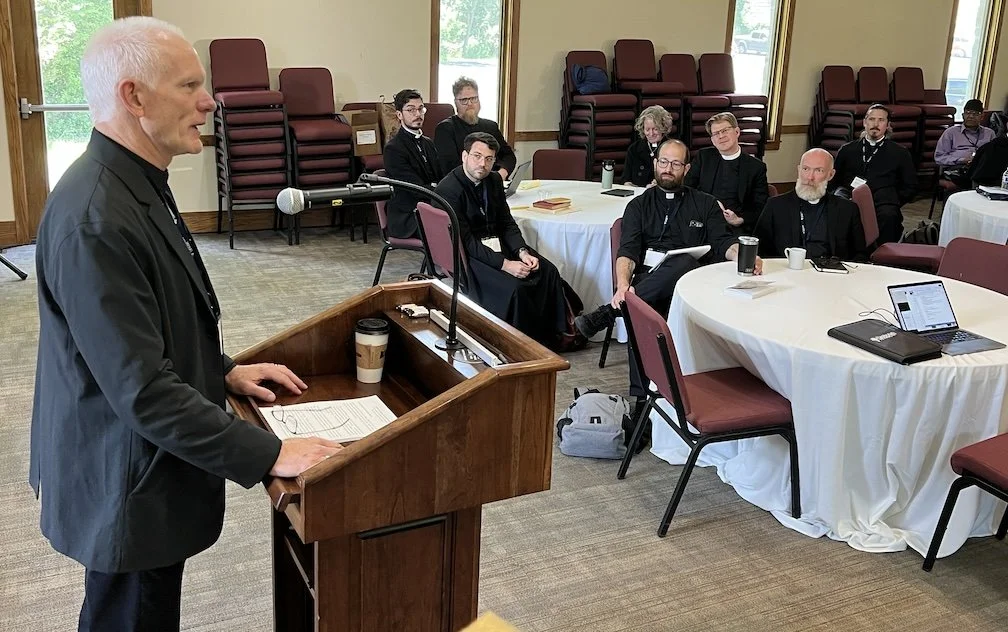
Bp. Scarlett addresses conference attendees.
To read the remaining sections of the 4,200-word presentation, or to download a PDF of the complete text, click here.
