Christian Proficiency: Forming the Remnant
A Presentation at the 2026 Breck Conference
The Rt. Rev. Stephen C. Scarlett
June 19, 2026
Editor’s Note: Below is Bp. Scarlett’s closing plenary address, delivered at the 2026 Breck Conference entitled “The Monastic Mountain in the Parish: Investigations in the Theology of Martin Thornton.” It was held June 17-19, 2026 at Nashotah House.
An introduction to the Remnant thesis
My task is to give a book report on Martin Thornton’s Christian Proficiency. Thornton wrote this book as a sequel to his book, Pastoral Theology: A Reorientation. It contains the same principles, but with a different audience in mind. As Thornton writes in the preface:
In my Pastoral Theology, I claim that parish planning should give priority to the needs and direction of the “faithful remnant . . . its emphasis is on theology and addressed mainly to clergy and students. In [Christian Proficiency] I have done my best to reverse the process and write directly for the faithful laity . . . modern counterparts to what medieval writers call proficients (ix).
Christian Proficiency will be read most profitably in the context of a community that has embraced the central assumptions of Thornton’s Remnant thesis. Thornton believed that the main focus of ministry in a church should be on the spiritual formation of the people who are committed to living a life of prayer— “the Remnant.”
In Pastoral Theology, Thornton contrasts the Remnant approach with “multitudinism,” which can be understood as the marketing approach to ministry. We try to get people to come to church by advertising our church products to religious consumers. While we naturally recoil from this label, it is embedded in our cultural approach to ministry. Consequently, the leaders of a church must work intentionally and perseveringly to reorient ministry around a different principle.
However, there is an equal and opposite error that is more dangerous for orthodox Anglicans. It is easy to misunderstand the Remnant as our angry little group of traditionalists or cultural warriors, who like to pick fights about fussy points of liturgy, marginal points of theology, or hot button political issues. None of these groups are Thornton’s Remnant. Thornton’s Remnant is the core group of people in a parish or mission that is committed to praying by the Rule of the church.
Thornton believed that ministry should be focused on what has traditionally been called ascetical theology. It is often referred to now as spiritual formation. Thornton believed that the Oxford Movement headed in the wrong direction in the next generation. As he wrote on page 112 of Pastoral Theology:
By a regrettable historical contingency, [the doctrinal reform of the Oxford Movement] led directly to revival of liturgical and ritualistic interests. This is, in some ways, tragic, not because ceremonial is unimportant—far from it—but because it came out of its true turn. The obvious child of this doctrinal reform is a rediscovery of ascetical practice in its fullness . . . . Had ascetic been reborn at the end of the nineteenth century, the liturgical problem would have been solved without all the bitterness, and silliness of the High Church—Low Church controversy that is still with us. Had the new-found Remnants of zeal been directed rather than taught, the Anglo-Catholic liturgy would have evolved simply and naturally (112).
When devotion to personal and communal formation precedes liturgy, liturgy becomes both a means of continuing formation and an expression of genuine devotion. When we skip the step of formation—and focus only on teaching theology—spiritual immaturity can turn the liturgy into a topic for debate or a point of personal preference. Thornton believed that the truly ancient and catholic way is rooted in a life of prayer that is measured by moral theology. Our prayer is effective when it results in a decrease in sin and an increase in virtue. This should be viewed chiefly as a growth in the virtue of charity: “By this all will know that you are my disciples, if you have love for one another” (Jn. 13:35).
Thornton taught that the Remnant’s formation and growth is the foundation for the church’s mission. As he writes in Pastoral Theology, “There is nothing more contagious than holiness, nothing more pervasive than prayer. This is precisely what the traditional church means by evangelism and what distinguishes it from recruitment” (24). If we want to bear witness for Christ in the world, then our communities must have something to bear witness to. The fruit of the Spirit must be evident. There must be a vibrant and attractive corporate life.
For all the complaining from traditionalists about our post-Christian world, the truth is that many people in our time want to grow closer to God and closer to other people. The mission problem is that churches are often unequipped to offer people these things. For traditional Anglicans, the orientation is often toward self-preservation rather than formation and mission. Thornton can help churches to reorient ministry and mission in new and fruitful ways.
Thornton did not believe theology was unimportant. Rather, he believed that the truly “orthodox” faith was rooted in a “speculative-affective synthesis” (English Spirituality, 48-49) As he writes in Christian Proficiency, “We cannot separate Christian prayer, Christian life, and Christian doctrine . . . heresy is not only wicked, but inefficient” (xi). Bad theology leads to disordered thinking. Neglect of prayer leads to ineffective Christian living.
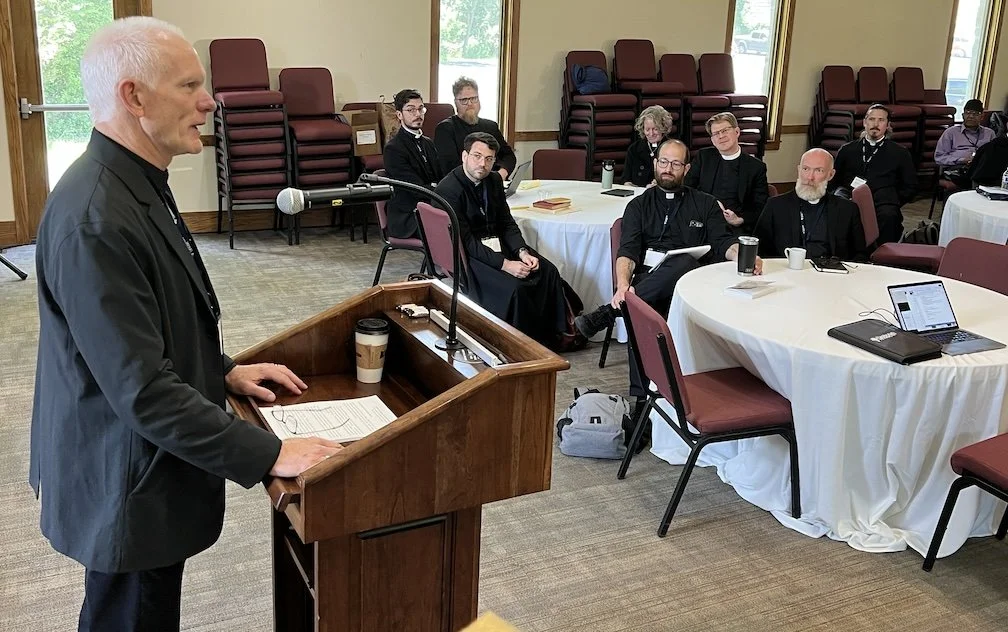
Bishop Scarlett addressing the 2026 Breck Conference.
Proficiency and the relationship between discipline and devotion
Thornton chose the world “proficiency” because the Christian life is a vocation. Proficiency in prayer is not just for personal improvement. It is part of our healthy impact on others. He writes, “A man’s influence on his neighbor depends upon his relationship with God, the Church’s impact on the world flows from her adoration; that is why our religion must forgo the pleasures of mere piety for spiritual efficiency” (xii).
Thornton discusses the relationship between discipline and devotion. Devotion is often associated with the heart and the emotions. However, those who reached the greatest heights of devotion in the church historically lived disciplined lives. St. Benedict referred to the Daily Office as ‘the work of God” (1). Good work requires discipline. The Anglican Rule is essentially Benedictine.
Thornton highlights the primacy of the will in the spiritual life. He writes, “The word devotion is liable to misinterpretation; it can be confused with mere emotion or a sentimental quest for nice feelings, whereas real devotion, like real faith, has its roots in volition” (2)--what you choose to do, even when you don’t feel like it. The word disciple is related to the word discipline (1). A practice of the faith rooted in a quest for good feelings leads to an aimless spirituality and an eventual loss of good feelings. A practice of the faith rooted in a volitional embrace of the church’s Rule leads to a growing affective experience over time. The will trains the emotions.
For example, one learns to swing a golf club the right way by constantly repeating the ideal swing until it becomes second nature. Practice can be tedious, but hitting the ball squarely and having it go where you want feels wonderful. Praying the Daily Offices can be tedious, but the experience of God’s presence that develops from the discipline over time in results in a greater subjective sense of God’s presence. One cannot develop proficiency, and a more deeply rooted affective experience, without a commitment to discipline.
The virtue of being faithful despite contrary feelings is recognized in other endeavors but is not always valued in the life prayer. Thornton notes that we laud the soldier, athlete, and worker who man their posts when tired or sick, yet, “If we assist at worship when we are ill, tired, or distracted, we are “irreverent,” and when a man under temptation struggles, falls, confesses struggles, falls, confesses, over and over again without despair, then he is a hypocrite” (3).
Christian identity and prayer
The vocation to pray is rooted in Christian identity. Thornton discusses “the three heavenly unities”: The union of the Holy Trinity, the union of God and man in Christ, and the union of Christ and his church. Baptism incorporates us into the new humanity of Christ. We acquire a new, eternal, supernatural status (10). Thornton writes, “The tremendous fact is that our fallen human nature can be redeemed, or renewed, or regenerated, by this new manhood of Christ; we can really share in the new humanity of Christ and, of special importance here, we can really share in his redemptive work” (8).
Baptism conveys a status that is a fact of our existence. We can be disobedient, and negligent Christians, but we can’t undo our baptism. We can represent our family poorly, but cannot undo our birth. As Thornton writes, “The baptized soul who does not “go to church” is irrevocably a Christian and will always be, but without the sacraments of grace he is living a lie, he is living outside of the truth of his own being, he is in fact the complete hypocrite—far more than all the wicked people who go to Mass and Confession” (12).
Conversion of the heart is important. Thornton calls it “an invitation to Baptism” (9). Ascetical theology views conversion as ongoing. We are continually converted by our experience of Christ’s presence in our prayer. Those who focus only on the initial experience of conversion tend to remain spiritually immature. We celebrate a baby’s birth. After that, we celebrate the child’s growth. The same principle should apply in the Christian life.
Prayer and good works
Thornton notes that good works flow from prayer, but they are not a substitute for prayer. He writes, “However many social welfare committees [a non-praying Christian] serves on, however many hospitals and homes he endows, he remains a moral ostrich; in the face of sin and suffering he is burying his head in the sand because he avoids the one and only channel of redemption” (12-13). This reflects the teaching of Jesus in John 15:4-5, “I am the vine, you are the branches. He who abides in Me, and I in him, bears much fruit; for without Me you can do nothing.” Thus Thornton notes, “Works of charity by Christians are linked with, are indeed part of the total prayer of the church” (15).
The Christian framework: The three-fold Rule
Thornton’s contends that the church has always observed a three-fold rule of prayer that consists of the Eucharist, the Daily Offices, and personal prayer. From the beginning, the church gathered on Sunday for what the Bible calls the Lord’s Supper, what the early church called the Eucharist, and what the later church called Mass or Holy Communion (1 Cor. 11:23-26, Acts 20:7).
The second part of the church’s Rule is “The Daily Office.” The biblical origin is in the Jewish practice of praying morning, noon, and night. Daniel prayed three times a day (See Dan 6:10-13). In Acts 10. An angel appears to Peter and Cornelius as they are praying at two of these hours. The early church universally observed the practice of praying at fixed hours. This developed into the liturgies that we call the Daily Offices. The Benedictine tradition expanded the early three hours to seven. The Book of Common Prayer reduced the hours to morning and evening to bring them into the practice of the whole church. Thornton argues that participation in the Rule by the whole church, clergy and laity together, is central to the Anglican Rule.
Thornton refers to the third category of prayer as “Private Prayer.” We exercise this part of Rule privately, but it is still a part of the prayer of the Body of Christ. Private prayer is the most subjective. We should pray in ways that work for us as unique individuals, while challenging ourselves to grow in areas of weakness.
Thornton argues that the ancient three-fold Rule is a mark of catholicity—just like the Nicene Creed. Thornton connects the Creed and Rule by means of the Holy Trinity. He writes,
In my Pastoral Theology, I have tried to show . . . how [Trinitarian Theology] finds practical expression in the Office objectively “given” to God Almighty, the Eucharist centred upon our Lord Jesus Christ, and private prayer inspired by the Holy Ghost. And it follows that the three parts of this framework—Office, Mass, private prayer—are as indissociable one from another as the Three persons of the Trinity himself” (18).
Thornton proposes the following. “Dare we think of the Eucharist as the living heart of the Body of Christ, of the Office as its continual beat, its pulse, and private prayer as the circulation of its blood giving life and strength to its several members according to their need and capacity?” (17). Thus, the church’s Rule provide balance in the life of prayer. Each part of prayer exercises a different muscle, but all are necessary for health.
Spiritual direction
Spiritual direction is essential for the Remnant’s spiritual progress. Thornton observes that “the self-taught are not usually very proficient” (25). We are caught up in our own interior struggles and thought processes. We need counsel from someone who can see us more objectively. Direction saves us from the tyranny of feelings (28) and enables us to practice “holy obedience.” In the Anglican tradition, direction is personal and relational. The reference point is the home and family, not the military (See English Spirituality, 57, 290f.).
Spiritual direction aids corporate efficiency. If we are struggling in our prayer, we are hurting the body and should get help. A player on a team who is struggling should seek out coaching advice for the good of the team. Spiritual friendships with mature Christian people who are faithful in their own lives of prayer can help fill the need for direction. A veteran player on the team can give helpful guidance to a more junior player even though the veteran is not technically a coach.
Private prayer
Thornton divides private prayer into three categories: Mental Prayer, Colloquy, and Recollection. However, he begins his discussion with the category he lists third. He notes. “Recollection is that which links up each part of Rule and welds all together into unity, so it can come first rather than last; rather like a ‘first Evensong’ which ends one day and begins another’ (59).
Recollection is the “practice of the presence of God” and, as Thornton notes, “it is usually divided into two related types, qualified by the adjectives habitual and actual. . . . The first pertains to a constant state of the soul, the second is a discipline whereby momentary acts of prayer are made periodically throughout the working day” (59). Thornton says that the “state of a soul described as (habitually) recollected is the highest degree of proficiency to which we can normally hope to attain” (59). The goal is to “pray without ceasing” (1 Thess. 5:17).
Recollection is the opposite of distraction (60). Distraction is the root of temptation and sin. Thornton describes the natural distracted state of the soul as follows: “Our souls, that is our selves, are like a jumbled heap of pins: interests, thoughts, emotions, volitions, and feelings—our life at work, our life of play, our domestic and social life, our life in the limelight and our life alone—all a heap of pins pointing in all directions but getting in one another’s way” (62).
Thornton then describes God as the force that brings order to the chaos. “The slow approach of a magnet sorts out this jumble in a remarkable way, confusion becomes a pattern, each pin points in the same direction, and all is achieved by the focus of a magnetic power. It is superfluous to add that the only magnet which can sort out the intricacies of the human soul is God” (62).
Recollection is fostered by the habit of turning to God throughout the day. Thornton notes that “The actual method chosen is of little importance so long as the acts are made, say, five or six times a day” (65).
Mental prayer
Thornton describes mental prayer as “a generic term for all the manifold ways and means of forming [an] initial introduction to God” (72). This form of prayer is centered on mental images that are cultivated, for example, by reflecting on a gospel story and its setting, or by reflecting on an icon or religious symbol. The current liturgical feast or season can be used as a foundation for mental prayer. For example, at Christmas we can meditate on the gospel narratives about Christ’s birth or on icons that portray the Incarnation.
Thornton notes that we should use images that we find edifying, but we should beware of captivity to period forms of art or personal preferences that may give us a less than complete image of Jesus. For example, we may prefer traditional images of Christ in stained glass or icons, but meditating on an image of Christ in a modern setting and in modern dress might give us a better sense of how Christ is with us now.
Our meditations should be balanced by theology. This is the speculative-affective synthesis. For example, Jesus is God and man. Our meditations should capture both aspects of the Incarnation. However, at times our focus may be on the humanity and at other times on the divinity. Images of Mary and the saints can help us to focus on the communion of the saints. We can see them as people who are with us in the same way as our living fellow Christians (see 77-80).
Colloquy: Talking with God
Thornton refers to the practice of talking to God as “colloquy” (87). Thornton says we should talk to God in our ordinary language, which is distinct from the language of liturgy. Thornton observes that “a modernized liturgy would be subjective precisely where we want it to be objective, but a stylized conversation with God will be objective where we want it to be subjective” (90).
Praying for others is part of our work as members of the Body of Christ. Thornton says we should know what we mean when we say, “I will pray for you.” We should consider how many names we will keep on our list, for how long, and how often we will pray for them. Thornton opines that “most Regulars should be able to cope with forty or fifty names a day; even allowing for some slight recollection of each subject” (102). There is a distinction between prayer and intercession. Praying for someone implies mentioning them in our prayers. Intercession requires greater emotional investment. We cannot intercede for more than a person or two at a time (102).
Thornton focuses on its ascetical value of confession. He notes, “The Christian proficient should be more concerned with progress towards Adoration that merely being saved” Avoiding things not deemed “generally necessary to salvation” “suggests the sportsman who plays just hard enough not to be dropped from the team, instead of playing as well as he possibly can” (110-11).
Aids and advantages
Thornton give practical advice about prayer under the heading of “Aids and Advantages.” For example, for spiritual reading there are books on “theology” that aim at the head, and books on “devotion” that aim at the heart. Thornton says we should balance our reading with, “the slightest coercion towards the opposite of our natural bent” (122).
Retreats provide an opportunity to establish the practice of the three-fold Rule and, thus, to set the pattern for the rest of our lives. Retreats also allow us to pray in community with others. They develop a certain sense of unspoken closeness or koinonia.
Difficulties and dangers
Thornton discusses obstacles to prayer under the heading, “Difficulties and dangers.” For example, one difficulty is aridity, which dryness or a lack of fervor. Thornton notes that “Aridity is a complement bestowed on us by God who trusts us to serve him without immediate or tangible reward” (130). And it is, “Most important of all—a sign of progress” (Christian Proficiency, 130). This important for a culture that associates feelings with vibrant spirituality.
Scrupulosity is “a serious spiritual disease in which the soul is perpetually oppressed by moral quibbles exaggerated out of all proportion” (134). The opposite of scrupulosity is a careless attitude that does not feel any tension over failures with regard to Rule. The balance is found in the state of “being at home” in the routine of our Rule while also being reverent. Thornton says this is like a good driver who is both comfortable behind the wheel but also attentive (134).
What do we do when we can’t find the ideal church? Spiritually mature people can adapt to difficult circumstances. Thornton writes, “Any sort of maturity demands a certain humility, resilience, and loyalty; however much things conflict with my own temperament” (147). What about getting along with difficult people in church? Thornton notes that “It seems tragic that men and women who accept . . . [communal give and take] as normal and necessary to creative living are put out by the slightest deviation and distraction in parochial affairs” (148).
Christian maturity
Thornton concludes Christian Proficiency with a discussion about Christian maturity. There is both temptation and pressure to adapt to some ideal notion of what a Christian should be. Thornton notes that “We must try . . . to discover how our Lord would have the Christ-like virtues manifested in our own unique personality” (157). Thornton says that “Christian life in the world flows not so much from outside “principles” as from habitual recollection . . . And I would suggest that the mature proficient Christian is the one who follows his natural bent just in so far as it is consistent with habitual recollection” (159).
Thornton says that Christian maturity is characterized by: “A unique, personal ‘Christlikeness,’ a wide sacramentalism which resolves a series of paradoxes, and a sane unobtrusive zeal for evangelism and apologetic” (171). These attributes are developed through a commitment to the “practical and progressive” ascetical approach to religion” (171).
Thornton highlights the danger of a book on ascetical theology and Rule. He writes, “We run the risk of the farmer who, having read a treatise on the diseases of poultry, found it quite impossible to imagine a healthy hen” (174). He says his aim is fairly modest. “If one reader is encouraged to experiment with Rule and direction, and to rethink his religious life in terms of workmanlike proficiency, I do not think I shall have wasted my time” (175).
Concluding thoughts
I began by saying that Christian Proficiency will be most profitably read in a community that embraces Thornton’s Remnant thesis. A question can be posed. If we are not training our committed people to live by the Rule of the church; if we are not directing them in their lives of prayer with the goal of helping them grow into Christian maturity, then what are we doing in church? The alternatives are manifest in our culture. We may be marketing church products to religious consumers. We may be complaining about the non-Christian culture. We may be arguing about politics, liturgy, or marginal points of theology. I believe that a fruitful future for Anglo Catholic ministry and mission depends upon Thornton’s proposed reorientation of Anglican faith around ascetical practice.
How do we do pursue this reorientation? In the Diocese of the Holy Trinity, we have reoriented our approach to ministry through a series of year-long spiritual formation classes. Christian Proficiency is part of our curriculum. We invite our most committed members to participate by email. To be invited, one must attend church regularly, contribute to the church, and be involved in ministry. We do not try to market or sell the class. It is not announced in church. Those who are invited must commit to attending classes over a ten month period, from September through June.
Personal invitation and the requirement of commitment are key parts of the distinction between recruiting or marketing, on the one hand, and challenging people to embrace their Christian vocation, on the other. As one of my professors said, “Jesus didn’t recruit volunteers. He said, ‘Follow me.’” Those who follow are the Remnant. Ministerial energy should be focused on them.
Over the last decade, our program has had a transformative impact on St. Matthew’s Church in Newport Beach, CA. It is beginning to have a transformative impact on other churches in our diocese where a Remnant group has joined our program. It has been encouraging to discover that busy people are willing to make a commitment to spiritual formation in community. People want to be closer to God and closer to other people in the church. We must provide the opportunity and the challenge.
Thornton’s teaching can be a foundation for the renewal of our churches. However, Thornton lived in twentieth century England. We live in a different time and place. We must build upon his foundation and apply his principles in new ways in our time. For example, we have had Morning and Evening Prayer online every day for about five years now. There was no internet when Thornton wrote. Thornton gives us the timeless principles of the church’s Rule of prayer. We must embrace the challenge of how to reorient ministry around these principles now. Christian Proficiency provides a good starting point for the conversation.
Martin Thornton: A Select Remnant Bibliography
Thornton, Martin. Christian Proficiency. London: SPCK, 1988. Reprint, Eugene, OR: Wipf and Stock, 2005.
——. Pastoral Theology, A Reorientation. London: SPCK, 1958. Reprint, Eugene, OR: Wipf and Stock, 2010.
——. English Spirituality: An Outline of Ascetical Theology According to the English Pastoral Tradition. Cambridge, MA: Cowley, 1986.
——. Spiritual Direction. London: SPCK, 1984. Reprint, Eugene, OR: Wipf and Stock, 2012.
——. The Rock and the River: An Encounter between Traditional Spirituality and Modern Thought. New York: Morehouse-Barlow, 1965.
——. Feed My Lambs. Essays in Pastoral Reconstruction. Greenwich, CT: Seabury Press, 1961.