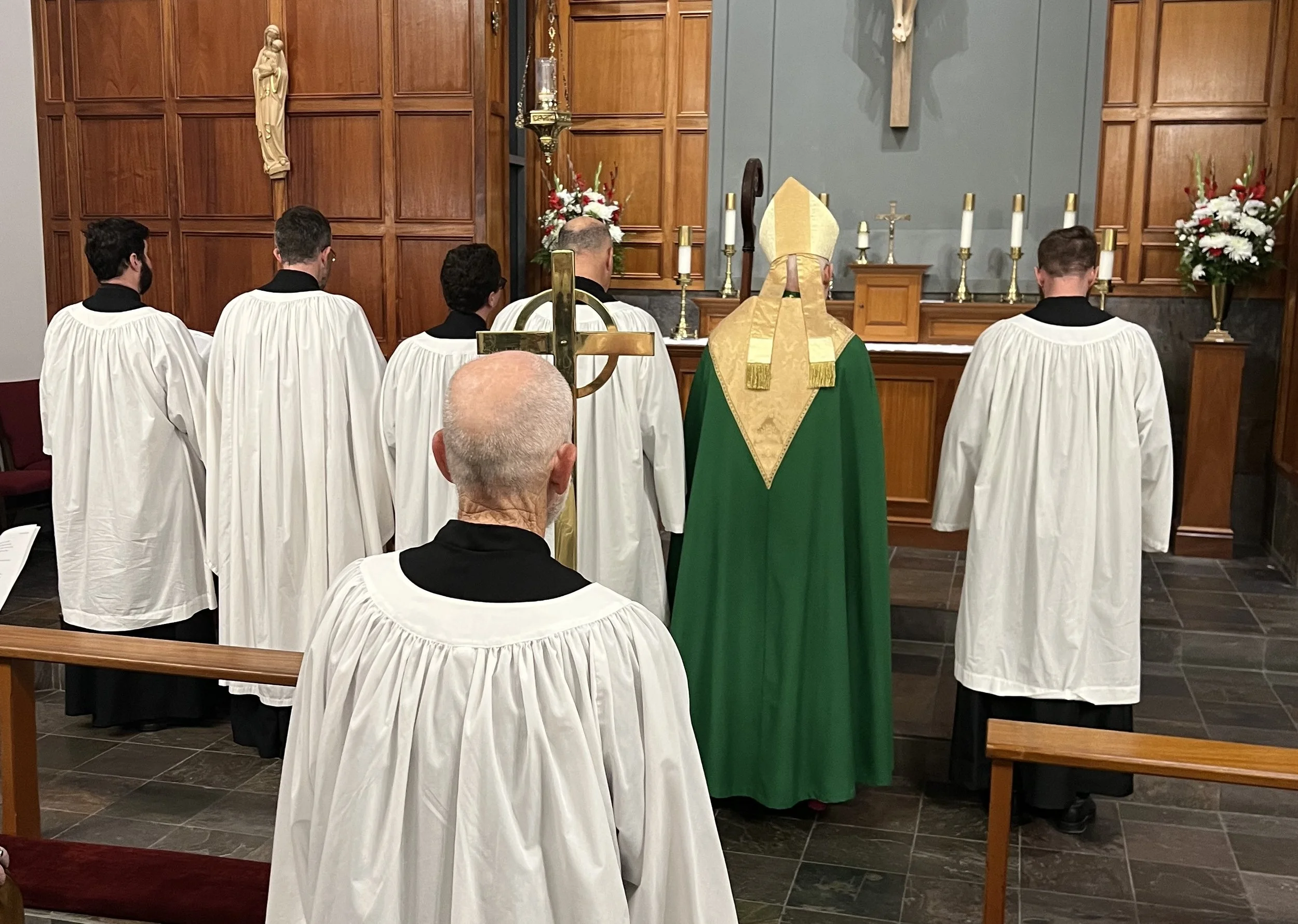
A sermon preached at the evensong marking Bp. Scarlett’s 40th anniversary at St. Matthew’s, September 25, 2026
I have a few thoughts to share on my fortieth anniversary at St. Matthew’s Church, which coincides with my resignation as Rector.
First, I want to clarify what is happening because there is some confusion. I fear that after time passes, people may say, “I thought you retired. Why are you still here?” There is problem with the words. I did not use the word retirement, because I am not retiring. I think retirement is a bad idea. But resignation sounds like I’m quitting. I’m neither retiring nor quitting. I am giving up the title of Rector of St. Matthew’s Church, for two reasons. One is to focus on the mission work of the Diocese of the Holy Trinity. St. Matthew’s Church is the “pro-Cathedral.” This stands for “provisional cathedral,” so named because that is where the bishop is. I will remain resident at St. Matthew’s as bishop.
The other reason for the transition is to make room for younger leadership to grow in their gifts and ministries, and to be present as Bishop to help those gifts and ministries develop. The goal is to continue our fruitful ministry into the next generation. I will have been here exactly forty years as of this coming Sunday. My first service recorded in our register was on October 5, 1986. Forty years seems like a good biblical time for this transition.
Thanks for Perseverance
Tonight is an opportunity to give thanks for what God has done for us, and to celebrate our life together in Christ. I’m not entirely comfortable with events held in my honor, but I am deeply moved by the labor and planning so many have put into this evening. I am very grateful for you! Thank you. I am also happy to provide justification for a great party!
First and foremost, I want to give glory and thanks to God for what he has let participate in here. God took an angry and aimless young man, called him to faith, and gave him a ministry with meaning and purpose. A central life theme I have learned is God’s providential ordering of all things. St. Paul tells in Romans that “God works in all things for good for those who love him and are the called according to his purpose” (8:28). I have learned to be grateful for things that I used to regret because I know see how God has work in them to form me. This perspective of faith, hope, and love is not possible part from the cross of our Lord Jesus Christ, whose suffering for us enables all of our pain to work for good. Thus, first of all, “Praise God from whom all blessing flow.”
I want to thank you for persevering with me in this work. In a culture focused on immediate gratification, I’ve learned that fruitful ministry develops in the other direction. Only by persevering in faith through pain, disappointment, conflict, and discouragement can God work through us to build something enduring.
I want to recognize five people who have been here longer than me. Dan and Sue Guggenheim, Jeff and Mary Anne Welles, and Marilyn Lambach are all founding members of St. Mathew’s Church. They were at St Matthew’s when it started forty five years ago. There were challenges and conflicts during those first five years. There was only a church for me to come to because these people, along with other saints now departed from us, sustained the church through those early years. I am very grateful for your presence and your faithfulness.
St. Matthew’s Church met in an upper room at the Community Church on Heliotrope Avenue in Corona del Mar for its first seven years. In 1988, we moved to a location across the street from Newport Harbor High School. The building was owned by the Zonta Club, a women’s organization. Our ministry grew in that place. However, the Zonta Club decided to sell their building (it is now condominiums) and we couldn’t afford to buy it. Our next move was to lease space on Westcliff Drive in Newport Beach behind the Pizza Bakery. We met there for about ten years. Our ministry grew and developed in that space. During that decade we purchased this piece of property.
The space we leased was not ready for us by the time we had to leave the Zonta Club. The landlord gave us another, temporary space to meet in. It had been a retail business called, “Lollipops and Rainbows.” The large sign with that wording was still hanging over the door of the building while we met there. For some reason, attendance dropped for a while!
For the last two years of our building project, we met in in space we leased in Costa Mesa on Bay Street, in a building that used to house the Daily Pilot newspaper. We moved here twenty-five years ago this coming Pentecost. We should start planning that party!
Four Decades of Providence
Someone at this church once said. “Most people overestimate what they can accomplish in a year, and underestimate what they can accomplish in ten years.” This is a good lens through which to summarize what God has done here.
The first decade. I came in 1986. After the first year, I was not sure that this was going to work out. I called my late friend and mentor Bishop John Cahoon to share my thoughts. He encouraged me to stay the course. Ten years later we signed a contract with the Irvine Company to buy this piece of property. That purchase was made possible by a series of providential events. I will share just one. After we made an offer on this property, Dan and Sue Guggenheim went to Idaho as is their custom. Sue had invited a friend and her husband, whom Dan did not know, to stay with them. The husband turned out to be the Irvine Company executive who oversaw this piece of property. He would have great influence on their decision to sell the property to us. Dan was able to have a little bit of influence on that decision! Thus, the decade that began with doubts about our viability ended with our purchase of a ideal piece of property for mission and ministry.
The second decade. The next ten years were a time of building the church and our ministry. From the time I came here in 1986, I prayed that God would send us mission minded younger people. This is not because God values the young more than the old. It is because a living church must give birth to spiritual children. I never viewed our church as a traditionalist movement, aimed at people who were dissatisfied and angry. I had been converted into and deeply formed by the ascetical discipline and ethos of the Anglican Tradition. I believe we have a gospel and transformative life of faith to share with everyone. Our faith cannot be just for ourselves. It cannot be a club. The God who became man to die for us and save us wants us to make sacrifices to share our faith with others.
In the mid to late 1990’s, we began to pray seriously about our mission. Deacon Bob Blythin, who is now retired in Texas, was a valuable partner with me in this conversation. We knew we would have a tremendous opportunity for mission in our new church building. We began to pray and think about how to welcome people using our gifts of hospitality and teaching. My prayer that began in 1986 was answered in earnest in the years after we moved into this church in 2002. We began to get an annual influx of students and younger people from Biola University and other places. Typically, these young people had been raised as non-denominational evangelicals and were hungry for a more deeply rooted practice of the faith. They also tended to pair up. For several years we had six to eight weddings a year. Our second decade was a decade of ministry development and growth. It began with a piece of property, It ended with a thriving ministry.
The third decade. The third decade was a time of challenge, disappointment, learning, and growth. After the influx of younger people, we were excited to expand our mission. We invested in mission efforts, which I expected would help to renew other churches and expand our mission to other places. Unfortunately, many of these efforts hit a wall. Some of our missionaries abandoned the work they were sent out to do. Then we encountered financial challenges, highlighted by a drastic decrease in our preschool enrollment one year. We had to tighten our belts and reassess things.
I asked myself, “What’s wrong with this picture?” The answer that came to me was that we had not sufficiently formed our people and missionaries in the faith. When youth and enthusiasm that is not deeply rooted in the spiritual life encounters challenges, mission is easily derailed by trials. In fact, mission carried out by people of any age who are not sufficiently formed is easily derailed by trials. See the Parable of the Sower and Seed (Luke 8:5-15). Thus, our third decade began with a vision for mission and ended with a series of painful lessons.
The fourth decade. I was convicted that we had to reorient our ministry around spiritual formation aimed at long term spiritual growth. We began a series of year-long classes that we call our Pastoral Ministry Program. The last ten years have been a reorientation of ministry around developing our life of prayer as a community and focusing on personal spiritual growth within that context. Our ministry is now centered on the practice of spiritual direction. This approach to ministry focuses on guiding people in their lives of prayer, helping them to discern how God is at work in their lives, and how they are called to use their gifts to serve God and others.
I’ve learned that the years of challenge and disappointment were in fact a gift. We often ask God for things and wonder why he does not give them to us. I’ve learned that God focuses on forming us into the kind of people who can receive the good things he wants to give us—like a good parent training his children. I am grateful for God’s discipline and the hard lessons we learned. We are a healthier church as a result. We are better prepared for the mission that God will give us over the next decade.
A Time to Feast
This weekend is time to pause at the end of four decades, and four and a half decades, to give thanks and celebrate. Celebration is an important part of the ascetical discipline of the church. The Christian experience of time is a harmony of fasting and feasting, of self-reflection and confession, on the one hand, and rejoicing in the forgiveness of our sins and God’s grace on the other. If our celebration is not rooted in Christ and his work in us, it can become a mere attempt to escape from our pain. However, if our practice of penitence is not complemented by a celebration of God’s goodness to us, our faith can become joyless and somber.
Part of our growth as a church is that we have learned to celebrate better. Tonight’s party is evidence of our developed proficiency. God instructs us to celebrate. Deuteronomy describes what God wanted his people to do with one of the offerings he commanded them to make. Deuteronomy 14:26, says "You shall spend that money for whatever your heart desires: for oxen or sheep, for wine or similar drink, for whatever your heart desires; you shall eat there before the Lord your God, and you shall rejoice, you and your household.”
Thus, in obedience to God’s commandment, let us celebrate and rejoice tonight in all that God has done for us and given to us. Thank you all for everything! I am extremely grateful for you and our life together in Christ!