A sermon for Easter Sunday 2026
Let’s be honest. Easter is strange. There is an empty tomb, uninhabited by the dead body that was locked in three days ago. Then the man who died appeared to various people telling them he is alive. Then the various people to whom he appeared, whom he has known for years, did not recognize him. They were able to “see” him only after he gave them the gift of sight.
The message of the Easter gospel hinges on the various meanings of the word “saw.” Three different Greek words are translated by our one word, “saw.” Mary Magdalene came to the tomb early and “saw” (blepo, βλέπω) that the stone was moved and the tomb was open. Then John came and “saw” (in the same way) the linen cloths. Mary and John looked at the stone and the cloths without any understanding of what they meant.
Then Peter, loser of the Easter race, entered the tomb and also “saw” (theoreo, θεωρέω) the linen cloths lying there. Peter’s seeing implies that he tried to figure out what it meant.
Finally, John entered the tomb. He “saw (eido, εἴδω) and believed.” John, by tradition the author of the account, humbly proclaims himself to be both the winner of the Easter race and the first person to understanding the resurrection. John “saw” with understanding as he connected the empty tomb with biblical prophesies and Jesus own words, which become clearer in that moment.
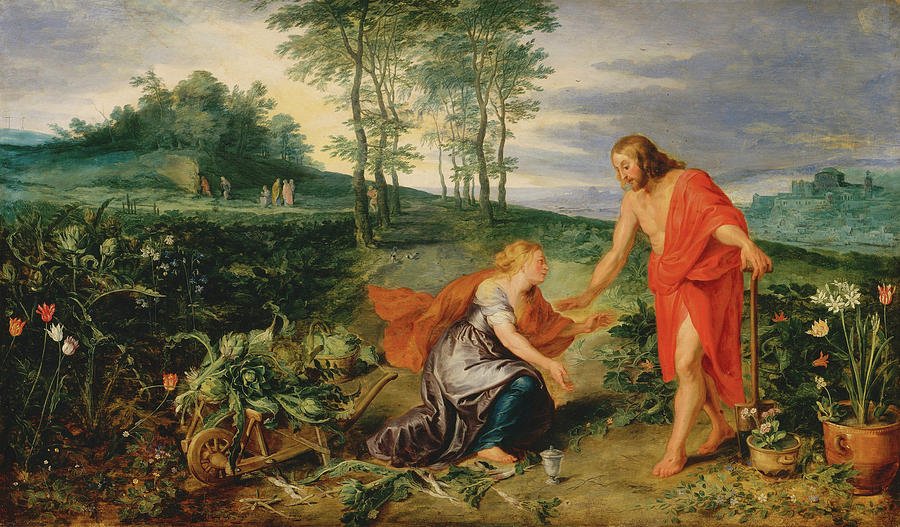
But Mary needed a personal revelation. Mary looked right at Jesus, but did not see that it was Jesus.” She recognized him only after “Jesus said to her, ‘Mary!’”—only after the Good Shepherd called his sheep by name (John 10:3).
To have faith means to see in the sense of having experiential knowledge. As Hebrews says, “Faith is the substance of things hoped for, the evidence of things not seen” (Heb 11:1). By faith we see things that ordinary human vision cannot see. As we say in the Creed, “I believe in God the Father Almighty, Maker of heaven and earth. And of all things visible and invisible.” What faith sees is real, but invisible to those who do not have eyes of faith to see. As 2 Corinthians 4:18 says, “We do not look at the things which are seen, but at the things which are not seen. For the things which are seen are temporary, but the things which are not seen are eternal.”
People talk about taking “a leap of faith,” by which they mean taking a risk in the face of doubt. Faith, in this sense, bridges the gap between knowledge and uncertainty. This is not biblical faith. When people act on faith in the Bible, they act on what faith enables them to see and know about God. What they see and know by faith is more certain than mere physical reality.
In our time, people tend to think that physical things are real and spiritual things are unreal or less real. Sometime faith in God is contrasted with “the real world.” However, this inability to see and know spiritual truth is a consequence of sin. It is spiritual blindness. When we live our physical lives in ignorance of spiritual reality and truth, our physical lives become unreal.
Our epistle says, “If you then were raised with Christ, seek those things which are above where Christ is, seated at the right hand of God.” We were raised with Christ in baptism through faith. As we live the life of prayer in Christ by faith, our vision is gradually restored. We grow in our ability to see things as they really are and live according to the truth—and not by the deceptions and illusions of merely physical things.
The epistle goes on to say, “When Christ who is our life appears, then you also will appear with Him in glory.” The word for appear means to reveal, “to make visible or known what has been hidden or unknown.” When Christ is revealed at the end of time, he will not travel from some distant point in outer space to earth. Rather, the spiritual reality that is here right now will be uncovered. As 1 Corinthians says, “Now we see in a glass darkly, but then face to face” (1 Cor 13:13).
Later on Easter Day, the Risen Christ appeared to two men on the road to a city called Emmaus (See Luke 24:13-32). They walked with Jesus for seven miles but did not “see” him. At the end of the journey, Jesus entered their home. St. Luke says that Jesus “took bread, blessed and broke it, and gave it to them. Then their eyes were opened and they knew Him” (Luke 24:30-31).
This story points to the regular way the Risen Christ is revealed to us. When we take bread, bless it, break it, and give it after the pattern of Jesus, we see the Risen Christ. Jesus commanded us to “Do this in remembrance of me” because we forget. To forget is to lose sight of the truth about Jesus and who we are in relationship to him. When we forget, we become blind again. We live in the darkness of the merely physical world. In the liturgy of Word and Sacrament, our eyes are opened again, and we see him and know him again.
Easter is a time to renew our faith and receive again the gift of sight. If our faith is weak so that we cannot see very well, we can pray in the words of the father in Mark 9:24, “Lord I believe; help my unbelief.” If our heart has become hardened so that we have come to value the merely physical world over the real world of faith, we can heed the words of Jesus to Thomas, “Be not faithless, but believing” (John 20:27). If we have faith, we can pray for God to give us clearer vision. We can pray in the words of St. Paul to the Ephesians:
That the God of our Lord Jesus Christ, the Father of glory, may give [us] the spirit of wisdom and revelation in the knowledge of [Jesus Christ], [that] the eyes of [our] understanding being enlightened, [we] may know what is the hope of His calling, what are the riches of the glory of His inheritance in the saints, and what is the exceeding greatness of His power toward us who believe (Eph 1:17-19).
On Good Friday the true meaning of love was revealed. Now, on Easter, the Risen Christ appears to us to give us the gift of faith so that we can see him and know him and live in the fullness of our resurrection hope. For “[we] died and our lives are hidden with Christ in God. When Christ who is our life appears, then [we] will also appear with him in glory.”
